The Sine with Dwell Test
Many countries are requiring Electronic Stability Control (ESC) safety systems on new vehicles. In the USA, nearly all vehicles sold after September 2011 must be equipped with ESC and comply with the regulation FMVSS 126, published in 2007. The FMVSS 126 requirements were more or less duplicated into the United Nations ECE R13H, which applies to European Union countries and many countries in Asia. Both FMVSS 126 and ECE R13H define a test procedure that uses the Sine with Dwell maneuver. Most vehicles will fail the test if not equipped with ESC (Figure 1).
OEMs simulate the sine with dwell maneuver in order to comply with both regulations. In the case of FMVSS 126, the OEM must be confident that any vehicle sold in the USA would pass the specified procedure if tested. A combination of testing and simulation is done to gain this confidence. In the case of ECE R13H, the regulation specifically allows simulation to be used for some vehicles, if the simulation has been validated through comparison with physical test results.
Shortly after FMVSS 126 was published in 2007, Mechanical Simulation posted a tech memo and example run for use with CarSim. Since then, OEMs have gained experience using simulation to comply with both FMVSS 126 and ECE R13H, and CarSim has been further developed to provide more built-in programming to simplify the simulation of this test series. All CarSim versions since 8.0 have come with sine with dwell examples installed.
Click here to view the tech memo describing the methods used (33-page PDF file).

Summary of the Procedure
FMVSS 126 is described in an 88-page document that is part of the Federal Register, Vol. 72, No. 66, April 6, 2007. The standard itself (571.126) is presented in six pages (pp. 17310 – 17315); the description needed to simulate the test is presented in just a few paragraphs.
Slowly Increasing Steer
The simulation test procedure begins with a “Slowly Increasing Steer Test” intended to determine the steering wheel angle A associated with a lateral acceleration of 0.3g for a speed of 80 km/h with the steering angle increasing at a rate of 13.5 deg/s. When performed via physical testing, three tests are repeated for counter-clockwise steering up to a lateral acceleration of 0.5 g; the steering angle at exactly 0.3 g’s of lateral acceleration is calculated using linear regression for each test, and the three results are averaged. The sequence is repeated for clockwise steering, and the absolute angles obtained in the two directions are averaged to obtain A.
Sine with Dwell
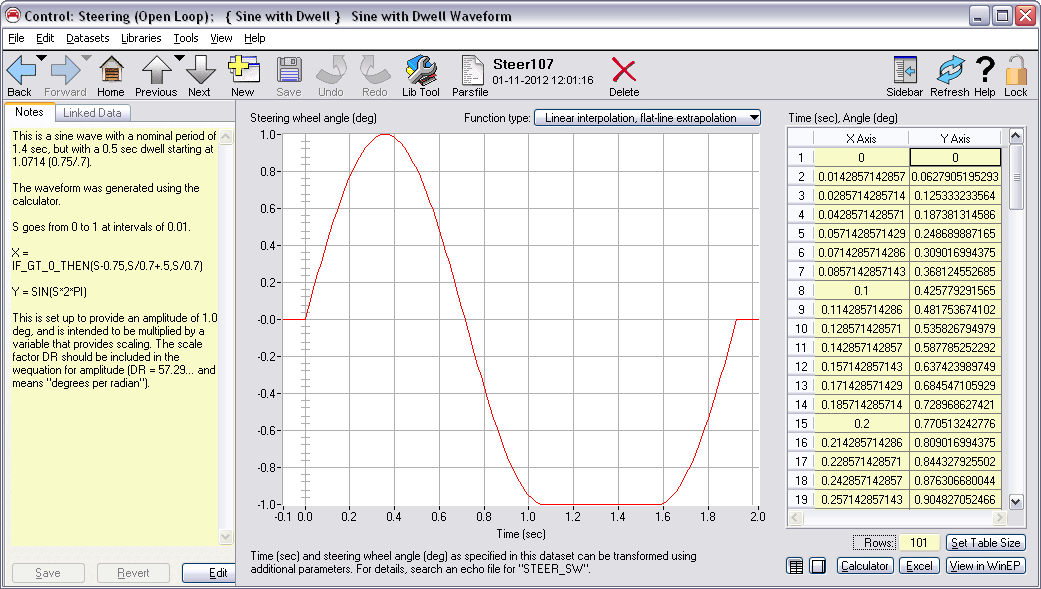
A "sine with dwell" test involves bringing the vehicle to a speed slightly above 80 km/h with no steering or braking, letting it coast in the highest gear to 80 km/h, and then using a robot to apply a steering control with the shape shown in Figure 2.
Two series of tests are conducted with this waveform (one with initially positive steer, as shown in the Figure, and one with the sign reversed). In the first test, the waveform is scaled by 1.5•A. If the vehicle passes the test, then the amplitude is increased for the next test by an increment of 0.5•A. The final run in a series is reached when the amplitude is greater than 270 deg. (Also, if the amplitude delta is greater than 300°, then the amplitude for the final run is reduced to 300 deg).
The success or failure of each test in the series is based on the vehicle state at three specific times releative to the start of the steering:
- If the Gain is 5.0 or greater, then a lateral displacement check is made at 1.07 sec. The lateral displacement of the vehicle mass center must be 1.83 m (6 ft) or greater relative to the start of the test for vehicles with GVW of 3,500 kg or less. If the displacement is less, then the vehicle fails the test. For vehicles with GVW greater than 3,500 kg, the required lateral displacement is 1.52 m (5 ft).
- A peak yaw rate is obtained for the test. The instant yaw rate 1.0 sec after the steering stops is compared to the peak rate, and must be 35% of the peak rate or less. If the instant yaw rate is higher than 35% of the peak yaw rate, then the vehicle fails the test (e.g., Figure 1).
- The instant yaw rate 1.75 sec after the steering stops is compared to the peak rate, and must be 20% of the peak rate or less (S5.2.2, see Fig. 1). If the instant yaw rate is higher than 20% of the peak yaw rate, then the vehicle fails the test.
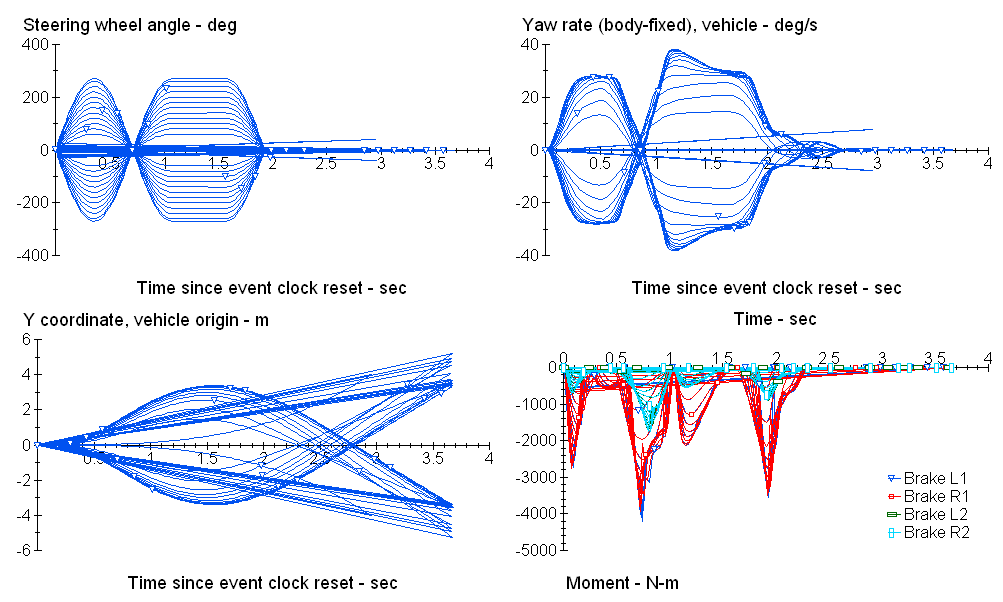
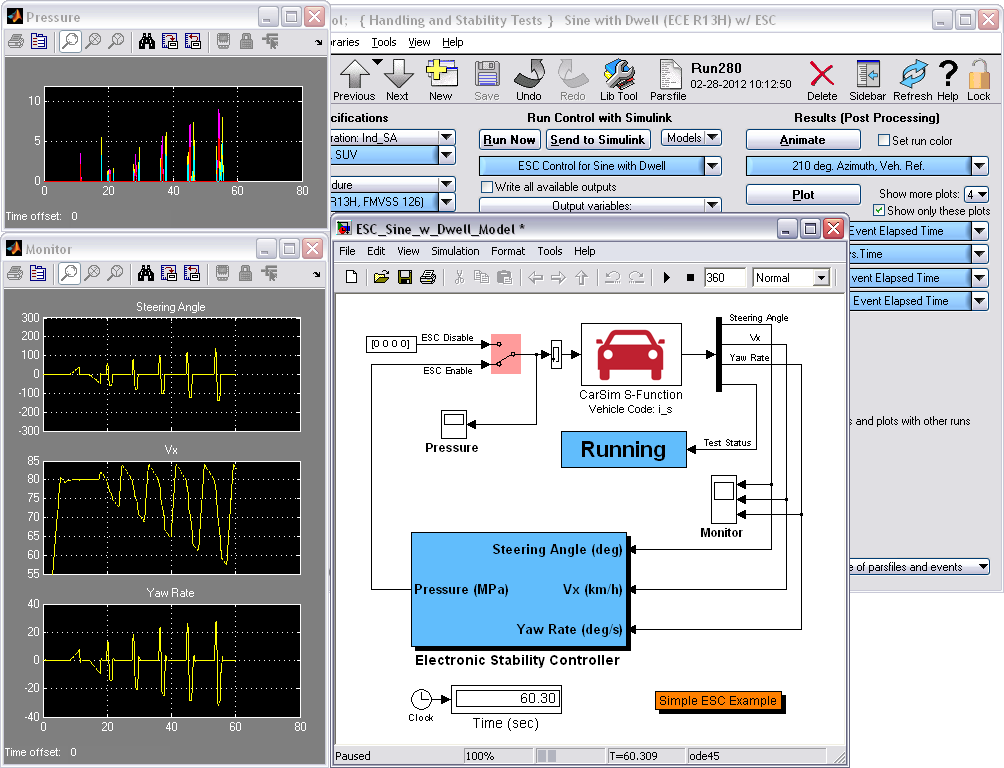
If the vehicle is tested to the final run in each direction and does not fail, then the vehicle passes the test. For example, Figure 3 shows plots obtained for a vehicle with ESC for all of the tests (both directions). Figure 4 shows the Simulink model with the ESC running with CarSim for the procedure.
Products
CarSimTruckSim
BikeSim
SuspensionSim
Applications
Automotive Industry OverviewExample: Electronic Stability Control
Example: TruckSim Tilt Table
Motorsports
Education